







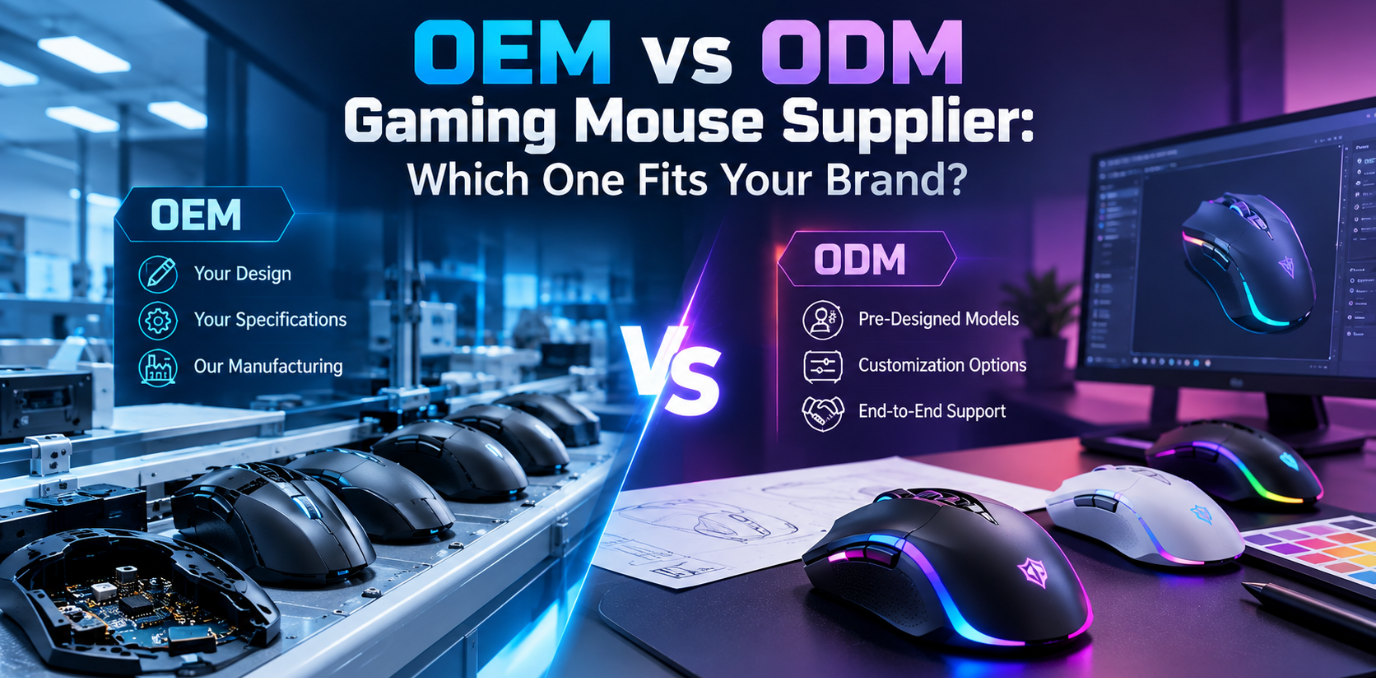

If you are building a private-label peripherals business, one of the first decisions is whether to go with an OEM or an ODM partner. The two terms get used loosely, but they lead to very different products, timelines and costs. Here is what separates them and how to pick the right gaming mouse supplier for your brand.
OEM and ODM, Explained Simply
OEM (Original Equipment Manufacturer) means the supplier builds a product to your specifications, or to a design you already have. You bring the design, the specs, or a reference sample, and the manufacturer produces it under your brand.
ODM (Original Design Manufacturer) means the supplier already has a ready-made product design. You select from their existing catalogue, apply your branding, and possibly request minor tweaks to colour, logo or packaging.
In short: OEM starts with your design, ODM starts with theirs.
OEM: When You Want Full Control
OEM suits brands that already know exactly what they want, or that are trying to stand out with a distinctive product.
Strengths:
- Full control over sensor choice, button layout, shape and materials
- A genuinely differentiated product rather than a reskinned catalogue item
- Better fit if you're also sourcing general computer accessories and want one design language across the range, whether you are working with a gaming line or a broader computer mouse supplier catalogue
Trade-offs:
- Higher upfront cost, since tooling and design work are project-specific
- Longer development time before the first unit ships
- Usually needs a higher minimum order quantity to justify the setup
ODM: When You Want Speed
ODM suits brands entering the market quickly, testing demand, or building a mouse range as one part of a wider product line.
Strengths:
- Faster time to market, since the design already exists and is proven
- Lower upfront cost, no tooling investment needed
- Easier to build a full range quickly, gaming and office models included
Trade-offs:
- Less differentiation, since competitors may access similar base designs
- Customization is usually limited to branding, colour and packaging
- Less control over deeper spec changes such as sensor swaps
Questions to Decide Which Path Fits You
- Do you have a design or reference sample already, or are you starting from a blank page?
- How fast do you need product on shelves?
- What is your budget for tooling and development?
- Do you need one flagship product, or a full range covering gaming, office and USB-connected models?
- How important is exclusivity in your specific market?
What to Check Before Committing to Either Model
- Manufacturing capability and factory audits, not just a sales pitch
- Sample quality and consistency across a small trial batch
- Component sourcing, especially the sensor, switches and cable
- Certifications relevant to your target markets
- Realistic minimum order quantities and lead times
- Clear terms on IP ownership, particularly for OEM designs
Choosing a Supplier That Offers Both
Many growing brands don't stay in one lane. They might launch with an ODM product to test the market, then move to OEM once volume justifies the investment. A supplier that supports both paths saves you from switching partners mid-growth.
The product range also matters here. A supplier offering only high-end gaming models limits you if your customers also want a straightforward office mouse, a reliable USB mouse for everyday use, or a customizable RGB mouse for the gaming shelf. Covering all of these under one partner keeps your sourcing simple as your catalogue grows.
How Tiitan Supports OEM and ODM Mouse Projects
Tiitan OEM and ODM services, alongside contract manufacturing, compliance and certifications, and supply chain fulfilment, give brands a structured path whichever route they choose. Businesses that already have a design can move through OEM production, while those that want to launch faster can start from an existing catalogue and apply their own branding through ODM. For businesses and individual entrepreneurs exploring a private-label mouse range, this covers everything from initial sampling to bulk fulfilment under one partner. To discuss your requirements, reach out through the B2B page on the website.
FAQ
Q1: Is OEM or ODM cheaper to start with?
A: ODM is usually cheaper upfront since there's no tooling or design cost, while OEM requires investment in a custom design.
Q2: Can I switch from ODM to OEM later?
A: Yes, many brands start with ODM to test demand and move to OEM once they have volume to justify custom tooling.
Q3: Who owns the design in an OEM arrangement?
A: This depends on the contract, so IP ownership terms should be agreed and documented before production begins.
Q4: Does ODM mean the product isn't customizable at all?
A: No. Branding, colour, packaging and small feature tweaks are usually possible, but deeper spec changes are limited compared to OEM.
Q5: Should my supplier cover both gaming and office ranges?
A: It helps. A supplier covering both lets you build a full product catalogue without managing multiple vendor relationships.